
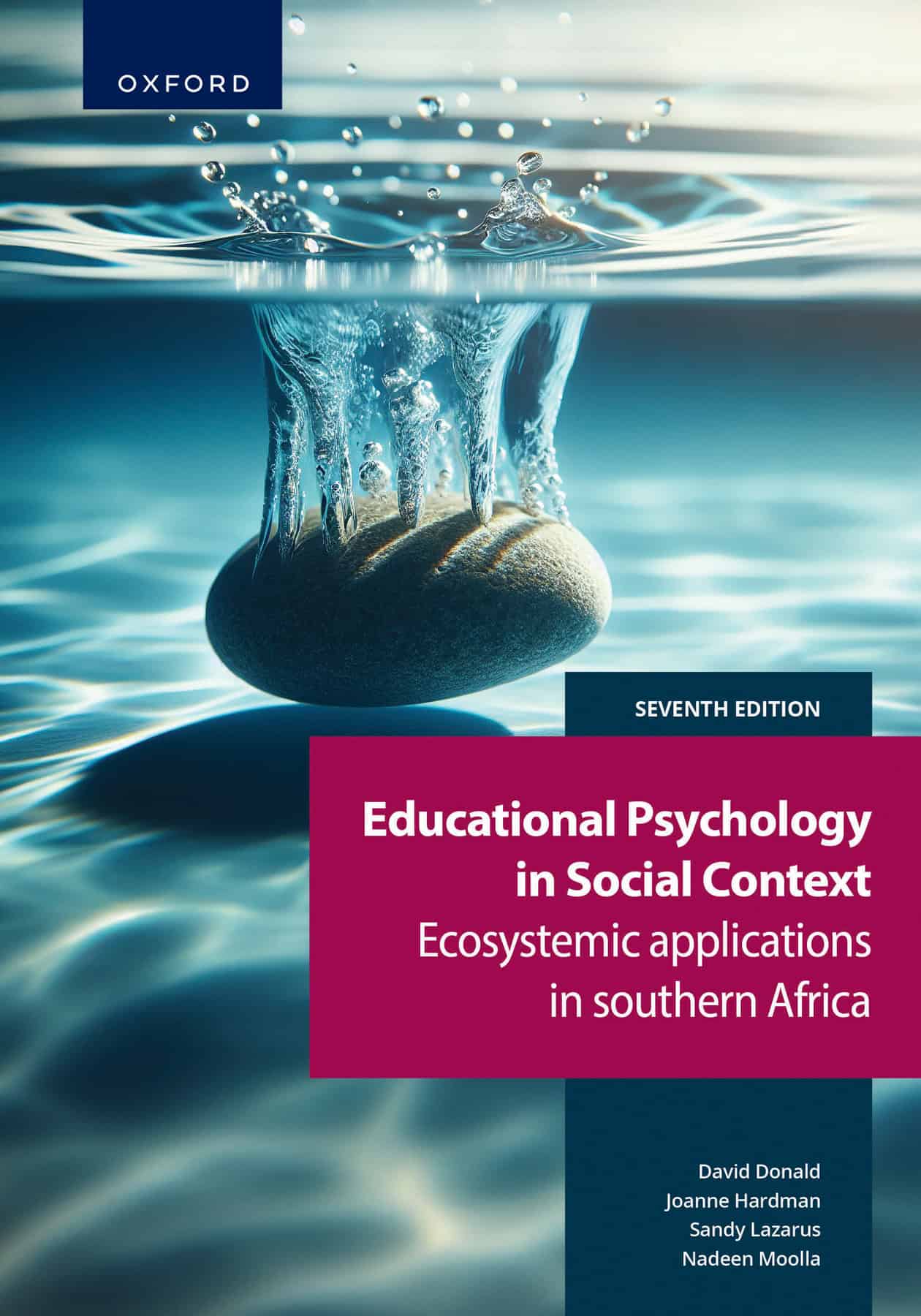
Educational Psychology in Social Context 7e
R649.95 (incl. VAT)
Educational psychology in social context: Ecosystemic applications in Southern Africa applies educational psychology to aid teachers and other educators to enhance the learning experience of students. The book uses Uri Bronfenbrenner’s Ecological systems theory as a guiding framework for understanding child development and the environmental barriers to learning faced by children. This ecosystemic approach examines how different spheres from the family to the community to wider social structures influence a child’s development and learning and how these interactions are impacted by the passage of time.
Educational Psychology in social context is relevant to both undergraduate and postgraduate study in either pre-service or
in-service teacher education. It can be used for courses in educational psychology in programmes such as BEd, BEd (Hons) and PGCE, and as a handbook for in-service teachers, educational psychologists, and other learning support professionals.
Educational Psychology in social context is relevant to both undergraduate and postgraduate study in either pre-service or
in-service teacher education. It can be used for courses in educational psychology in programmes such as BEd, BEd (Hons) and PGCE, and as a handbook for in-service teachers, educational psychologists, and other learning support professionals.
Features
- The new edition has been updated for contextual and theoretical developments and new research referenced where relevant.
- Chapter 2: Quality education for all includes guidance on ethical conduct within the school context including learners, parents, colleagues and communities. It also includes guidance on working with neurodiverse learners in the classroom.
- Chapter 4: Positive psychology includes more on mental health in the school context, as well as positive practical strategies for teachers to enhance the well-being of learners as well as the well-being of teachers.
- Chapter 6: Constructivism and learning contains a new section on developing a pedagogy that is inclusive of different voices and based on an ethics of care and recognition.
- Chapter 13: Substancen abuse and violence includes more content on school violence (violence within the school setting), a new section on teacher abuse, and expanded guidelines for conflict resolution and building safe schools.
- Chapter 14: Gender, se xu ality, relate
Additional information
| Author/s | |
|---|---|
| ISBN | 9780190778972 |
| Edition | 000000 |
| Publication Date | 06 Oct 2025 |
| Format | |
| Pages | 0 |
| Language |
