Four school dictionaries priced below R200 aim to help learners in Grades 4 to 9 build the language skills needed to understand and evaluate online answers
AI and online searches can give learners an answer in seconds. But finding a translation is not the same as understanding a word well enough to pronounce it, use it correctly or recognise its meaning in different contexts.
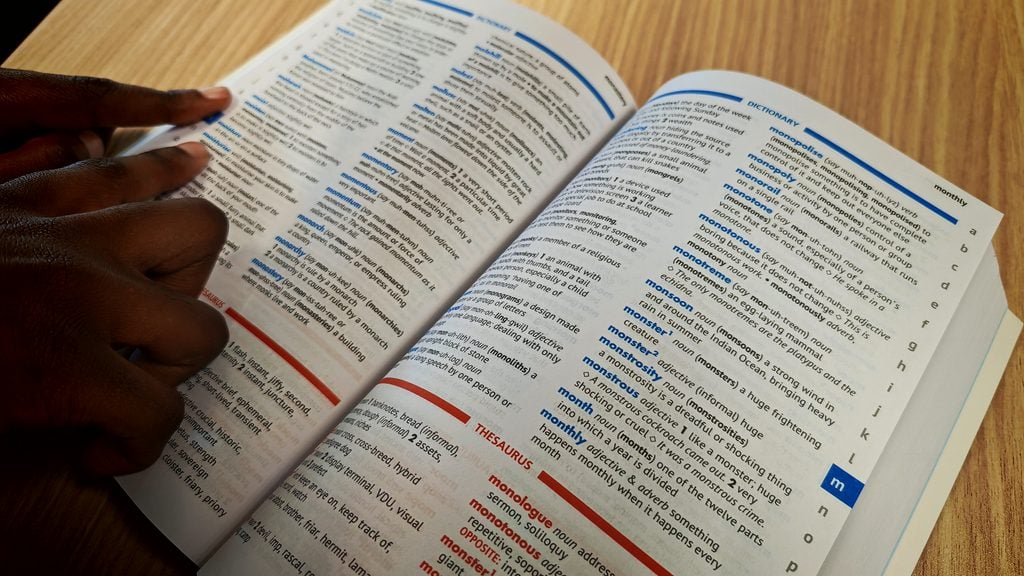
When a learner asks an AI tool or Google, “What is the English word for…?”, they may receive a quick translation. A bilingual school dictionary takes them further by providing the pronunciation, related word forms and examples of how the word is used.
The Department of Basic Education’s Funda Uphumelele National Survey, which assessed 28 000 learners across 710 schools, found that only around 30% of learners in Grades 1 to 3 met the relevant home-language reading benchmarks.
A small 2026 qualitative UCT study involving 10 coding and robotics educators also reported that learners were increasingly using AI to complete academic tasks without fully understanding or critically evaluating the answers.
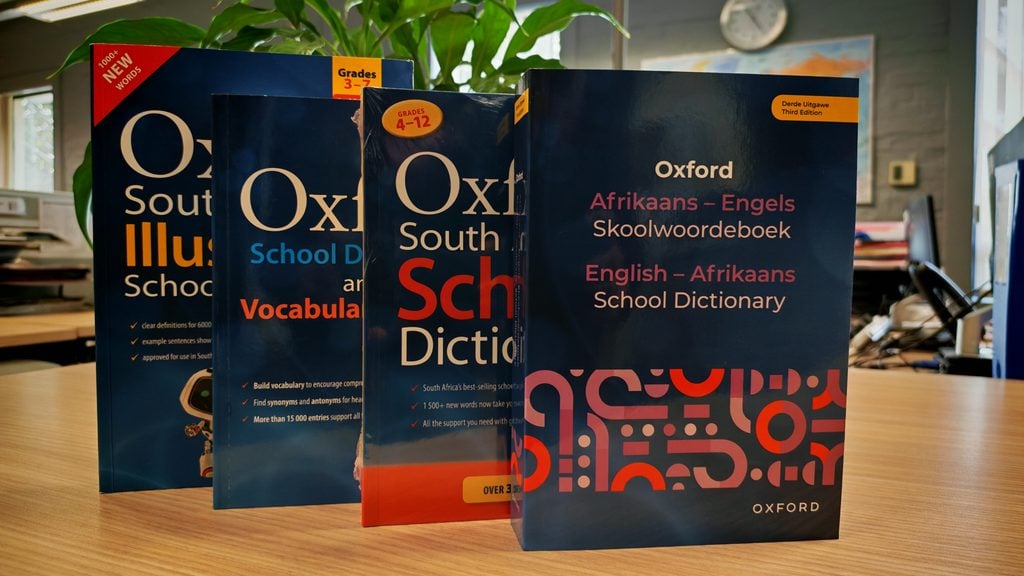
Against this backdrop, and with household budgets under pressure, Oxford University Press South Africa (OUPSA) has made four school dictionaries for Grades 4 to 9 available at recommended promotional prices below R200.
“A dictionary can support a learner for several years. By making these titles more affordable, we hope to give more parents, teachers and schools access to reliable language support without compromising the quality or content of the books,” says Dariol Wicomb, Dictionaries Publisher at OUPSA.
The newly published third edition of the Oxford Afrikaans–Engels Skoolwoordeboek English–Afrikaans School Dictionary includes more illustrations with bilingual labels, a revised pronunciation guide and Afrikaans and English vocabulary support for key school subjects.
The Oxford School Dictionary and Vocabulary Builder, OUPSA’s first locally developed school dictionary and thesaurus combination, includes familiar South African words such as “samoosa”, “kombi” and “koppie”, as well as a seven-page thesaurus guide. By introducing related words and meanings, it helps learners expand their vocabulary and choose words more confidently when speaking and writing.
“Printed and digital resources should not be positioned as opposites,” says Wicomb. “Used together, they give learners both speed and deeper understanding.”
“For example, a learner may ask an AI tool to translate an Afrikaans word into English and receive a direct answer. A bilingual school dictionary takes the learning further by showing the word’s pronunciation, related word forms, correct usage and different meanings in context. It also gives learners a reliable reference point for checking an AI-generated answer and using the word confidently themselves.”
Parents, teachers and schools can explore the Oxford Essential Dictionaries series, download sample pages and identify the most appropriate title for their learners at https://bit.ly/4g6tp7O
Dictionary titles included
The collection comprises the Oxford Afrikaans–Engels Skoolwoordeboek English–Afrikaans School Dictionary, Third Edition; the Oxford School Dictionary and Vocabulary Builder; the Oxford South African School Dictionary, Fourth Edition; and the Oxford South African Illustrated School Dictionary, Second Edition.