Making the decision

by | Dec 3, 2014 | Schools News

questions

“The best way to predict the future is to create it.”- Abraham Lincoln

It is important to follow a strategic decision-making process when making an informed
career choice. Share this five-step process called the PACED decision making Process with your learners to help guide them in making the best decision for their future.

P – Identify the Problem
Are you deciding on a career, a course to study or an institution to go to?

A – Identify Alternatives
List all the possibilities and alternatives that you have.

C – Analyse the information (Criteria)
Write down your criteria e.g. must be on a public transport route or within a certain budget

E – Evaluate the situation
Weigh up your alternatives against your criteria.

D – Decide on a solution
Make your final decision.

Some things to remember when making your decision:
1. Research as broadly as possible, and make a list of what interests you to explore in more depth.
2. Narrow your criteria down according to your interests and priorities.
3. Check that the career you choose fits in with your morals and values, and your finances.
4. Make an informed decision.

You may go through a decision-making process a number of times, as this process is cyclical.
It is essential to check that you have made the correct career decision.
Latest News

  • How Oxford Reading Buddy is transforming reading success across Curro schools 
    On 4 September 2026, Angelique Timms, Curriculum Lead at Curro, was a guest speaker at the annual Oxford Digital Africa: Future Learning Labs event held in Cape Town. She spoke on why digital learning is becoming increasingly embedded in education and that schools face a critical question: How can technology be used to meaningfully improve literacy outcomes rather than simply digitize traditional learning.
  • Oxford University Press SA puts four school dictionaries under R200 as learners turn to AI 
    Four school dictionaries priced below R200 aim to help learners in Grades 4 to 9 build the language skills needed to understand and evaluate online answers.
  • Oxford’s Literacy Magazine: A,B,See! vol. 4 
    In the 2026 edition of Oxford’s literacy magazine, A, B, See!, we build on the themes of the third issue and explore the transition that learners make from learning to read to reading to learn, and how the shift from the Foundation Phase to the Intermediate Phase is one of the most significant milestones in a learner’s educational journey.

Oxford CAPS approved

View online samples of our trusted classroom solutions and support material across all phases and subjects.

Bigger, better, brighter

and more beautiful than ever before!

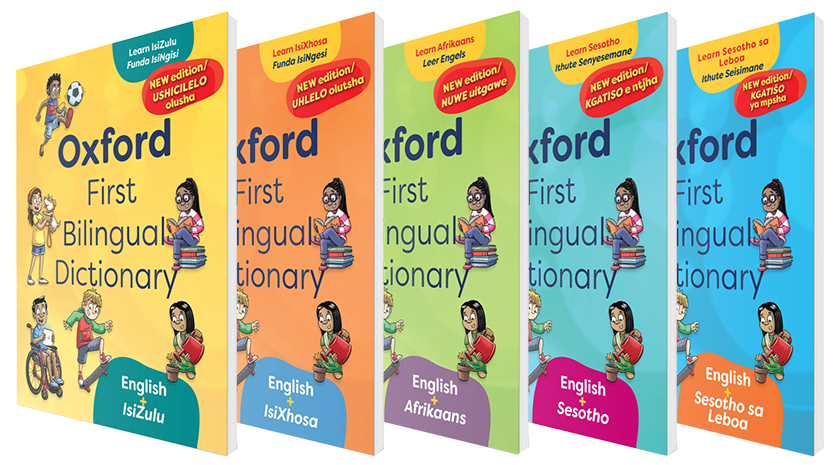
Brand new editions of our popular CAPS-linked bilingual dictionaries for South African learners in Grade R to 4

360° teaching at your fingertips

The all-in-one teacher’s toolbox