So English is not your first language? Not to worry. Having a conversation does not mean that you have to produce perfectly formed sentences all the time. Make use of the phrases below to keep the conversation going even if you do not know the exact word for something, or do not understand the meaning of everything the other person says:
presentation-december-2016

Here are a few examples:

Asking someone to speak more slowly

* Can you speak more slowly, please?
* Could you slow down a bit?
* Sorry, that was too fast for me. 

Checking that you understood correctly

* Have I understood you correctly – did you say …?
* Do you mean ‘frozen’, as in very cold?

 Asking what something means

* Sorry, can you tell me what XX means?
* What is XX, exactly?

 Asking how you spell something

* Could you spell that for me, please?
* How do you spell that name?

 When you don’t know how to say something

* Think about those words that are often used in dictionary definitions: a type of …, a kind of …, a device for …, a person who … They will help you explain what you mean even when you don’t know the exact word.

 Saying it another way

* We saw a kind of animal with a long nose. (elephant)
* It’s something you make with eggs. (omelette)

*Source: Oxford South African Pocket Dictionary, 4th edition 2015 (ISBN 978 0 19 904503 7)
Latest News

  • How Oxford Reading Buddy is transforming reading success across Curro schools 
    On 4 September 2026, Angelique Timms, Curriculum Lead at Curro, was a guest speaker at the annual Oxford Digital Africa: Future Learning Labs event held in Cape Town. She spoke on why digital learning is becoming increasingly embedded in education and that schools face a critical question: How can technology be used to meaningfully improve literacy outcomes rather than simply digitize traditional learning.
  • Oxford University Press SA puts four school dictionaries under R200 as learners turn to AI 
    Four school dictionaries priced below R200 aim to help learners in Grades 4 to 9 build the language skills needed to understand and evaluate online answers.
  • Oxford’s Literacy Magazine: A,B,See! vol. 4 
    In the 2026 edition of Oxford’s literacy magazine, A, B, See!, we build on the themes of the third issue and explore the transition that learners make from learning to read to reading to learn, and how the shift from the Foundation Phase to the Intermediate Phase is one of the most significant milestones in a learner’s educational journey.

Oxford CAPS approved

View online samples of our trusted classroom solutions and support material across all phases and subjects.

Bigger, better, brighter

and more beautiful than ever before!

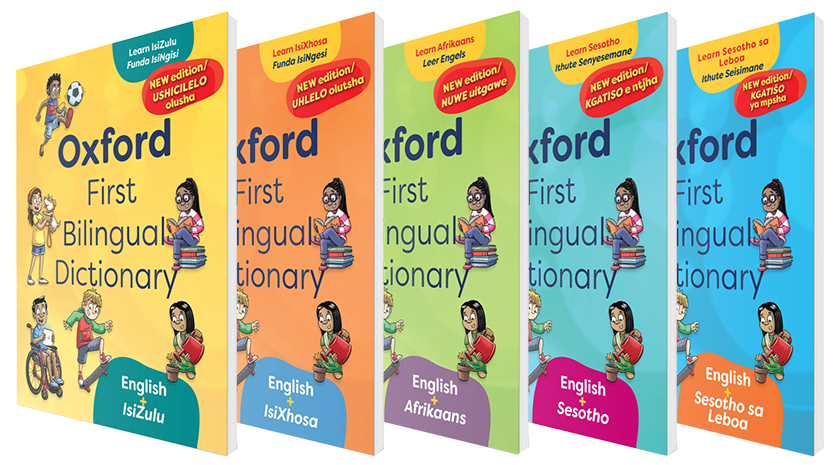
Brand new editions of our popular CAPS-linked bilingual dictionaries for South African learners in Grade R to 4

360° teaching at your fingertips

The all-in-one teacher’s toolbox